Los Angeles
Truck Accident
Attorney
A serious truck crash calls for a clear plan.
Commercial truck collisions can raise difficult questions about the driver, trucking company, insurance, and evidence. Bedford Law Group helps injured people in Los Angeles and Southern California evaluate their rights and pursue a supported injury claim.

Legal help after a commercial truck accident
A truck accident lawyer investigates how the collision happened, identifies potentially responsible parties, reviews applicable insurance, and documents the losses the crash caused. A commercial claim may require records that are not usually available at the roadside.
Bedford Law Group represents people injured in truck collisions. Our team connects the investigation to the medical, financial, and personal effects of the injury, then explains options for moving the claim forward.
From our Wilshire Boulevard office in Westwood, Los Angeles, we evaluate semi-truck, big-rig, delivery-truck, and other commercial vehicle collisions. Shawn Azizzadeh, Esq. is the firm’s attorney. Every matter receives an individual evaluation.

Understand the collision
Scene evidence, vehicle information, witness accounts, and carrier records help identify the questions that need answers.

Connect the evidence to your losses
The review considers potentially applicable policies and records documenting medical needs, missed work, and changes to daily life.

Plan the next step
Our team evaluates options for a claim, communicates about disputed issues, and develops a strategy for negotiation or litigation when appropriate.
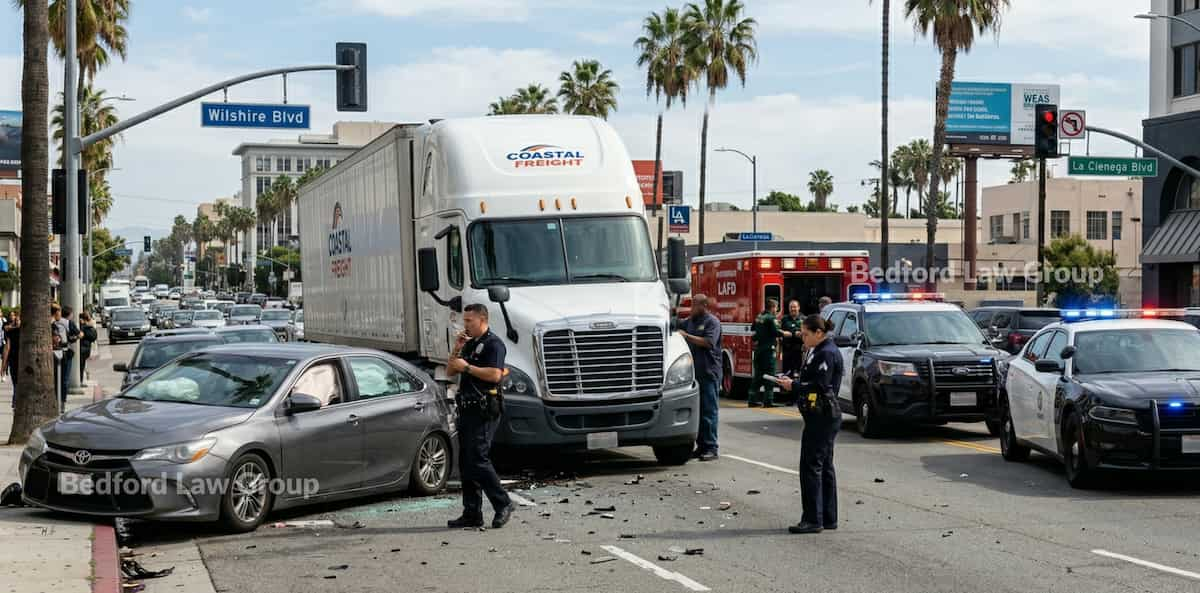
Illustrative scenes; not actual clients or case proceedings.
Experience with serious injury matters.
Selected Bedford Law Group verdicts and settlements include motorcycle and pedestrian matters, including collisions involving a truck, bus, or other commercial vehicle.
$8.85Million
Motorcycle Accident – Roadway Design Defect
$2.7Million
Pedestrian Hit by City Bus
$1.85Million
Fatal Motorcycle vs. Truck Accident
$1Million
Pedestrian Hit by Commercial Vehicle
These results involve different facts and case types. Past results do not guarantee, warrant, or predict the outcome of another matter.
How to choose a truck accident lawyer in Los Angeles
When comparing law firms, look beyond a “best lawyer” label. Ask questions that reveal whether the attorney has the relevant experience, resources, and communication approach for your situation.
- Relevant experience: Has the firm investigated commercial truck collisions, carrier responsibility, and similar injury or insurance issues?
- Clear responsibility: Who will manage the file, answer questions, and explain important decisions?
- A written fee agreement: How are attorney fees and case expenses handled, and what happens if there is no recovery?
- A realistic assessment: Will the legal team discuss strengths, risks, and deadlines without promising an outcome?
Check licensing through the State Bar of California, and read the attorney’s professional background.
Shawn Azizzadeh, Esq.
Managing Attorney & Founder
Bedford Law Group, APLC
Shawn founded the firm in 2003 and is licensed in California and Nevada. His practice focuses on personal injury representation.
View Shawn’s attorney profile →Bring questions about your work, family responsibilities, prior health, and the changes caused by the collision. These details help the legal team understand the person behind the file.
What to do after a Los Angeles truck accident
Get to safety and seek appropriate medical care. If there is an emergency, call 911. If you can gather information safely, keep it organized without putting yourself or anyone else at risk.
- Identify the truck: Photograph the carrier name, license plates, trailer, and any USDOT number that is visible.
- Preserve the scene: Keep photographs, original video files, witness contacts, and police report information.
- Keep your records: Save medical instructions, bills, work restrictions, and insurance correspondence.
- Ask about preservation: Prompt legal advice can help identify truck, camera, and carrier records that may need attention.
Truck evidence: what to preserve and why it matters
Different records answer different questions. Availability, accuracy, retention, and access vary. An investigation should examine the actual records rather than assume every truck has a complete recording of the collision.
| Record | Questions it may help answer | Important limitation |
|---|---|---|
| ECM / vehicle data | What operating information did the truck’s systems retain? | Available parameters and event records depend on the vehicle and equipment. |
| ELD / driver-duty records | What driving-time and duty information was recorded? | An ELD is not required to record speed, braking, steering, or other performance data. |
| Camera footage & witnesses | What can be seen or independently described about the sequence of events? | Video may not capture every angle or remain available indefinitely. |
| Dispatch & cargo documents | What trip, delivery, load, or communication information may be relevant? | The documents must be connected to the truck, trip, and issues in the claim. |
| Inspection & maintenance files | Were reported equipment issues inspected or addressed? | A record or defect must be evaluated alongside causation and the other evidence. |
FMCSA distinguishes required ELD information from vehicle-performance data in its ELD Functions FAQs.
Who may be responsible for a truck collision?
A truck collision may involve several people or businesses. Potential responsibility depends on the work performed, the relationships involved, the cause of the crash, and applicable law.
- Driver and motor carrier: Investigate driving conduct, the work relationship, training, and relevant carrier practices.
- Vehicle owner or maintenance provider: Review control of the equipment and any potentially relevant inspection, repair, or maintenance issue.
- Cargo-loading party: Examine who loaded or secured the cargo and whether a loading issue contributed to the collision.
- Component manufacturer: A suspected defective part requires technical and legal evaluation.
Identifying a business name is only a starting point. A claim needs evidence supporting a legal basis for responsibility and the harm alleged.
Which trucking rules may matter?
Relevant federal regulations can address driver qualifications, commercial driving, vehicle equipment, hours of service, and inspection, repair, and maintenance.
The rules that apply depend on the operation and circumstances. A possible violation needs to be evaluated in context, including whether it contributed to the crash.
FMCSA: 49 CFR Parts 300–399 · California Courts: personal injury cases
Truck accident cases we evaluate
The type of impact helps guide the investigation, but does not decide fault on its own. Our team reviews the available evidence for the particular collision.

Related matters: car accident claims, brain injury representation, and wrongful-death matters.
Rear-end & chain-reaction crashes
Review stopping distance, traffic conditions, available video, and the sequence of impacts.
Jackknife & rollover crashes
Examine steering, braking, loading, road conditions, and available vehicle records.
Wide turns & lane changes
Look at the vehicles’ positions, turn signals, visibility, and witness accounts.
Underride collisions
Preserve vehicle damage and information about the trailer and its equipment.
Lost cargo & loading issues
Investigate cargo condition, securement, weight distribution, and the work performed by each party.
Delivery & other commercial trucks
Identify the vehicle, driver’s work arrangement, carrier, and policies that may apply.
A practical path through a truck injury claim
The sequence varies by case. These stages explain how an investigation and claim may progress.
- 1
Listen & evaluate
Discuss the collision, your concerns, available records, and whether the firm can assist.
- 2
Preserve & investigate
Identify relevant records, responsible parties, and the evidence needed to understand the crash.
- 3
Document the impact
Organize medical, income, and other information supporting the claimed losses.
- 4
Present & negotiate
Evaluate coverage and disputed issues, then pursue a supported claim and assess any offers.
- 5
Litigate when appropriate
If necessary, pursue court proceedings and prepare the matter for the next stage.
Some stages overlap. The evidence, medical circumstances, insurance issues, and court process can affect timing. No settlement or completion date is guaranteed.
Truck accident claims and potential compensation
A claim should reflect supported losses, not a number based only on the size of the truck. Liability, causation, available insurance, and the evidence all matter.
Medical needs & ongoing care
Medical bills, treatment records, and appropriate professional assessments can document current needs and future effects of the injury.
Income & financial losses
Work and pay records, documented limitations, property damage, and related records help explain the financial impact.
Personal & emotional harm
Evidence about pain, emotional harm, and changes to daily activities can help explain losses that do not come with a receipt.
California Courts: evidence and damages in a personal injury case.
California truck accident filing deadlines
Personal injury lawsuits
California generally allows two years for many personal injury lawsuits under Code of Civil Procedure § 335.1. Exceptions can affect when a deadline begins or whether time is extended.
California Courts: deadlines to sueGovernment-related claims
If a government entity is involved, an administrative injury claim may be due within six months. Additional lawsuit deadlines and exceptions require separate review.
California Courts: government claimsPrepare for a free truck accident consultation
You do not need every record before contacting Bedford Law Group. Share what you have, explain your concerns, and ask who will communicate with you and how the next step will be decided.
Discuss attorney fees, case expenses, and the written representation agreement separately. A free consultation is an opportunity to ask questions; it is not a promise of a particular outcome.
Request a Free Case Review- Crash date, location, and police report details
- Truck, trailer, carrier name, plates, or USDOT number
- Scene photographs, original video, and witness contacts
- Insurance policies, letters, offers, and claim numbers
- Medical records, bills, and treatment instructions
- Missed-work records and related receipts
- Your questions and a timeline of communications
Los Angeles truck accident FAQs
General information for California claims. The facts, applicable rules, and insurance in your matter need individual review.
Ask about your situation ↗How do I choose a truck accident lawyer in Los Angeles?
Look for experience investigating commercial vehicle collisions, access to appropriate technical resources, a clear communication plan, and a candid explanation of fees and case costs. Check attorney licensing and read reviews in context. A “best” or “top-rated” label does not guarantee that a lawyer is the right fit for your circumstances.
Does Bedford Law Group offer a free truck accident consultation?
Yes. Bedford Law Group offers a free initial consultation to discuss a truck collision, available information, and whether the firm can assist. Call (310) 507-7900 or use the contact page. You do not need every document before asking for an evaluation. Attorney fees and case costs should be discussed separately before any representation agreement is signed.
Who can be held liable in a commercial trucking accident in California?
Depending on the evidence and applicable law, potentially responsible parties may include the driver, motor carrier, vehicle owner, cargo-loading company, maintenance provider, or a manufacturer of a defective component. Responsibility must be supported by the facts; being connected to a truck does not automatically make a person or business liable.
How is a truck accident claim different from a car accident claim?
A commercial truck claim may involve a separate driver, carrier, tractor owner, trailer owner, and several insurance policies. Driver-duty records, vehicle data, cargo documents, and applicable safety regulations may need review alongside the usual scene evidence and medical records.
What evidence should be preserved after a truck crash?
Potential evidence includes scene photographs, witness details, police reports, vehicle and carrier identifiers, camera footage, driver-duty and dispatch records, inspection files, cargo documents, and available vehicle data. The relevant records depend on the collision. Ask about preservation promptly, because some information can be lost or overwritten.
Is an ELD the same thing as a truck’s black box?
No. An electronic logging device (ELD) records information used to assess hours-of-service compliance. An electronic control module (ECM) may retain other operating information, depending on the equipment. FMCSA states that ELDs are not required to collect speed, braking, steering, or other vehicle-performance data.
Can electronic truck records establish who caused the crash?
Electronic records may help explain parts of a collision. Their significance depends on what was recorded, whether it was preserved, and how it fits with the other evidence. No single record automatically establishes every element of a claim.
Does a truck collision guarantee a larger settlement?
No. A claim’s potential value depends on supported injuries and losses, liability evidence, available coverage, and other case-specific factors. The size of the vehicle alone does not establish the amount that may be recovered.
What compensation may be available after a truck accident?
Depending on the claim and supporting evidence, compensation may address medical expenses, ongoing care, lost income, future effects of the injury, property damage, and pain or emotional harm. Each category requires a case-specific evaluation. An estimate is not a promise of recovery.
How long do I have to file a California truck accident injury lawsuit?
California generally allows two years for many personal injury lawsuits under Code of Civil Procedure section 335.1. Exceptions can affect the calculation. A claim involving a government entity may require an administrative claim within six months, followed by additional deadlines. Ask for an individual deadline review promptly.
Should I accept the trucking company’s insurance settlement offer?
Before signing a release, consider whether the proposed payment accounts for the documented effects of the injury and what claims the release would resolve. Give accurate information and comply with applicable reporting obligations, but seek legal advice about an offer or request you do not understand.
Will my truck accident case go to trial?
A claim may resolve through negotiation, while other matters require a lawsuit and further proceedings. The path depends on the evidence, disputed issues, and the parties’ positions. No attorney can guarantee a settlement, trial result, or completion date.
What should I bring to a truck accident consultation?
If available, bring the crash date and location, police report information, photographs, witness contacts, truck or carrier identifiers, insurance correspondence, medical bills, and missed-work records. Keep original files and a timeline of communications. Do not delay contacting the office just because records are incomplete.
Does Bedford Law Group handle truck crashes outside Los Angeles?
The firm evaluates truck accident matters throughout Los Angeles County and Southern California from its Wilshire Boulevard office. The firm also has a Las Vegas office for Nevada matters. This page explains California claims; a Nevada matter requires a separate review under Nevada law.
Sources: FMCSA ELD guidance · California Courts personal injury guide · filing deadlines.
Serving Los Angeles County and Southern California
Our main office is at 10960 Wilshire Boulevard, Suite 750, Los Angeles, CA 90024. The firm evaluates commercial truck accident claims from communities throughout the region. Service-area links describe availability; they do not imply a separate physical office in each city.
- Los Angeles County
- Santa Monica
- Beverly Hills
- Pasadena
- Burbank
- Glendale
- Long Beach
- Orange County
- San Diego County
For broader injury matters, visit California personal injury representation. For Nevada matters, see our Las Vegas office and services.
Discuss your next step with Bedford Law Group.
Tell us what happened, how you were affected, and what questions you need answered. We can evaluate whether the firm can assist with your truck accident matter.
Los Angeles main office
Bedford Law Group, APLC10960 Wilshire Boulevard, Suite 750
Los Angeles, CA 90024
ATTORNEY ADVERTISING. Shawn Azizzadeh, Esq. is the attorney responsible for this content. General information only; this page is not legal advice and does not create an attorney-client relationship. Prior results do not guarantee, warrant, or predict the outcome of another matter. Every case depends on its facts, applicable law, and available evidence.
Content updated October 30, 2026. Sources: FMCSA regulations, FMCSA ELD guidance, and California Courts.